How to solve sudoku step by step as a complete beginner
To solve a sudoku, you write a digit only when the rules prove it is the only one that fits. Fill the units that are almost full, scan each digit from 1 to 9 through the boxes, rows and columns, then pencil in candidates once scanning stops giving you digits. On easy grids those three moves often finish the puzzle. Pairs and the X-Wing come later, on harder grids.
How do you solve a sudoku step by step?
You run one short loop until the grid is full. Each new digit removes candidates from its row, column and box, and that often sets up the next placement.
- Fill any row, column or box that has a single empty cell.
- Take the digits 1 to 9 in turn and look for a box where that digit has only one possible cell.
- Run the same scan along the rows, then the columns, to find hidden singles.
- When scanning gives nothing, pencil in the candidates of every empty cell.
- Place any cell that has a single candidate, then cross that digit out of its row, column and box.
- After each placement, check the row, column and box of the new digit first, then go back to step 1.
- If a full pass places nothing, look for pairs, then for advanced techniques.
The sections below take these steps one at a time, with two example grids.
What rules do you need before you start?
Every row, every column and each of the nine 3×3 boxes must hold the digits 1 to 9, once each. That is the whole rule set, as Nikoli, the Japanese puzzle publisher, states it on its rules page. The digits printed at the start are the givens. When a puzzle has exactly one solution, every digit in it follows from the givens and the rules. A script checked that both grids in this guide have exactly one.
There is no arithmetic in sudoku. The digits work as labels, and nine letters would give you the same puzzle.
A few terms come back throughout this guide. A unit is any row, column or box. A candidate is a digit that can still go in an empty cell, given its row, column and box. Pencil marks are those candidates written small inside the cell. Cells are named like r2c3, which means row 2, column 3, counted from the top left corner.
Where do you start on a new grid?
Start with the units that are almost full. A row, column or box with one empty cell takes the one digit it is missing. This is the last free cell, the simplest move in the game.
Then scan by digit. Pick the 1 and look at each box that does not have one yet. The 1s already placed in the rows and columns crossing that box rule out some of its cells. If only one cell is left, the 1 goes there. This move is called the last remaining cell, or cross-hatching. Move on to the 2, then the 3, and so on up to 9.
Keep the same order each time you start a grid, for example boxes from top left to bottom right. With a fixed order, you can tell which digits you have already checked when you come back to the puzzle.
What does a hidden single look like?
A hidden single is a digit that has only one possible cell in a row, column or box. That cell may still accept other digits. The digit itself has nowhere else to go in the unit, so it goes there.
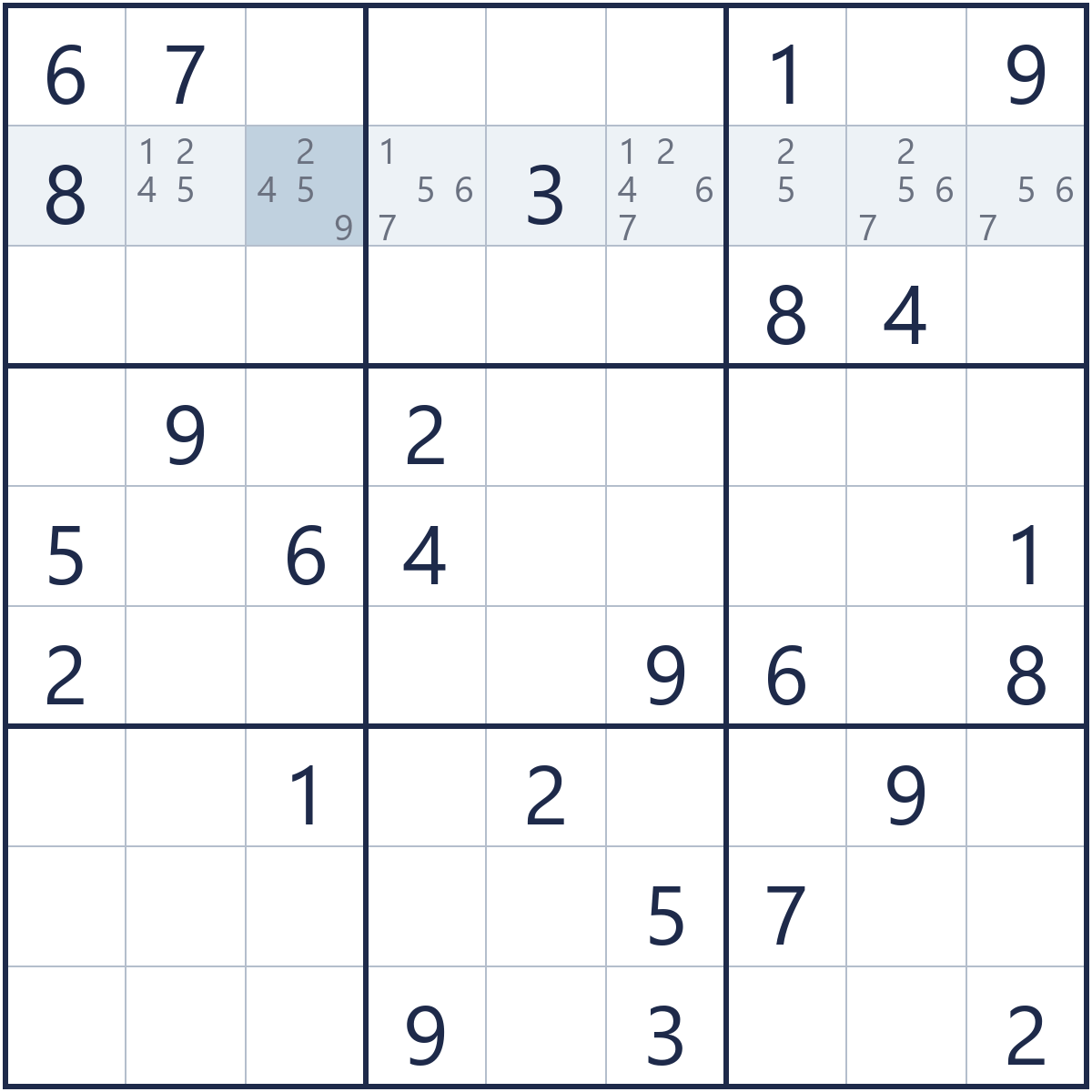
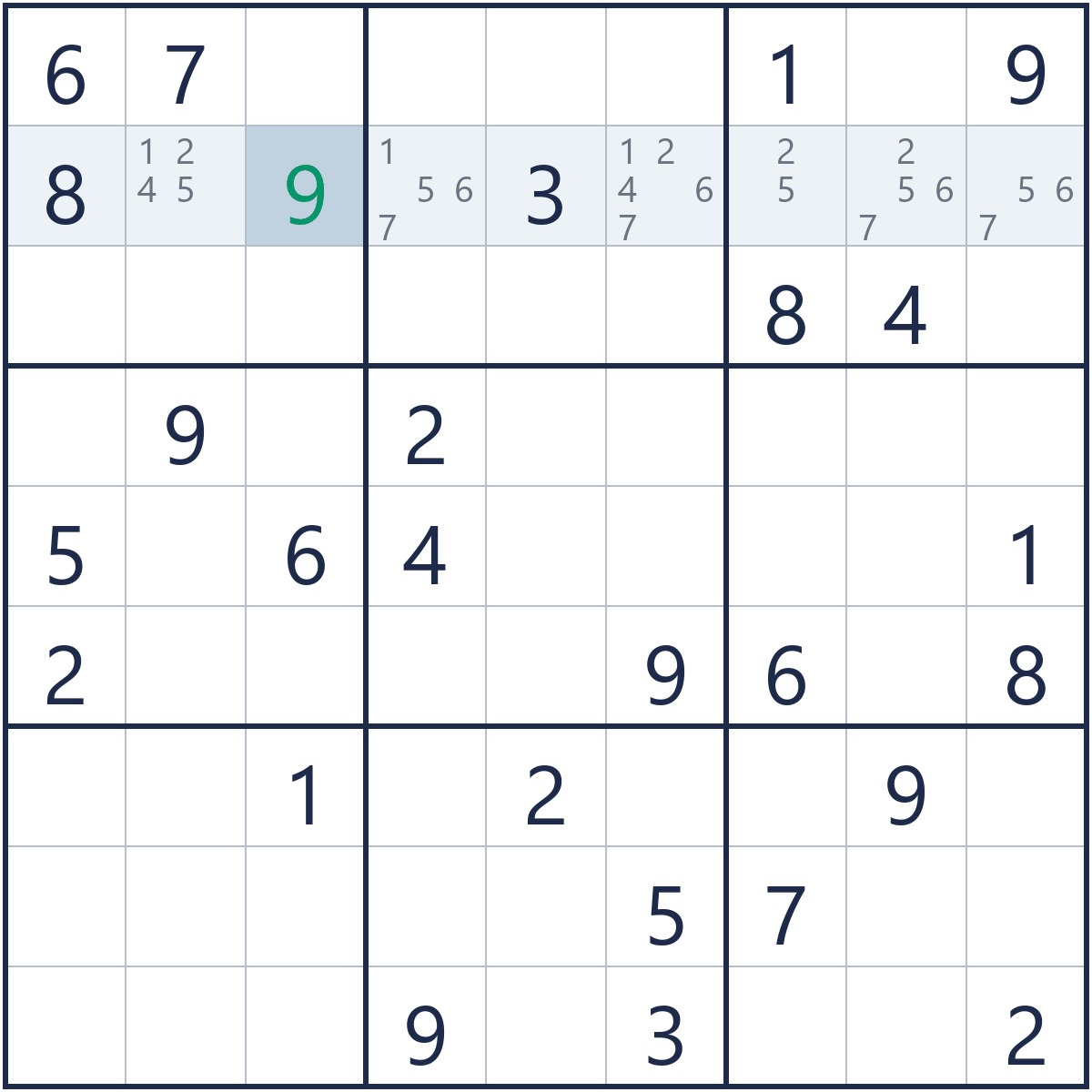
Row 2 holds an 8 and a 3 and has seven empty cells. The 9 in r1c9 rules out the three cells of row 2 that sit in the top right box. The 9s in r4c2, r9c4 and r6c6 rule out columns 2, 4 and 6. Only r2c3 is left, so the 9 goes there, even though that cell still accepts 2, 4 and 5.
Scanning by digit inside boxes finds the hidden singles of the boxes. Running the same check along rows and columns, as here, finds the ones the box scan misses.
When should you write candidates?
Write candidates when scanning stops producing digits. Written on a fresh grid, they go stale fast, because every placement changes the cells around it.
Pencil marks reveal the naked single, a cell with one candidate left. Some sites call it the last possible number. A hidden single starts from a digit looking for its cell. A naked single starts from a cell looking for its digit.
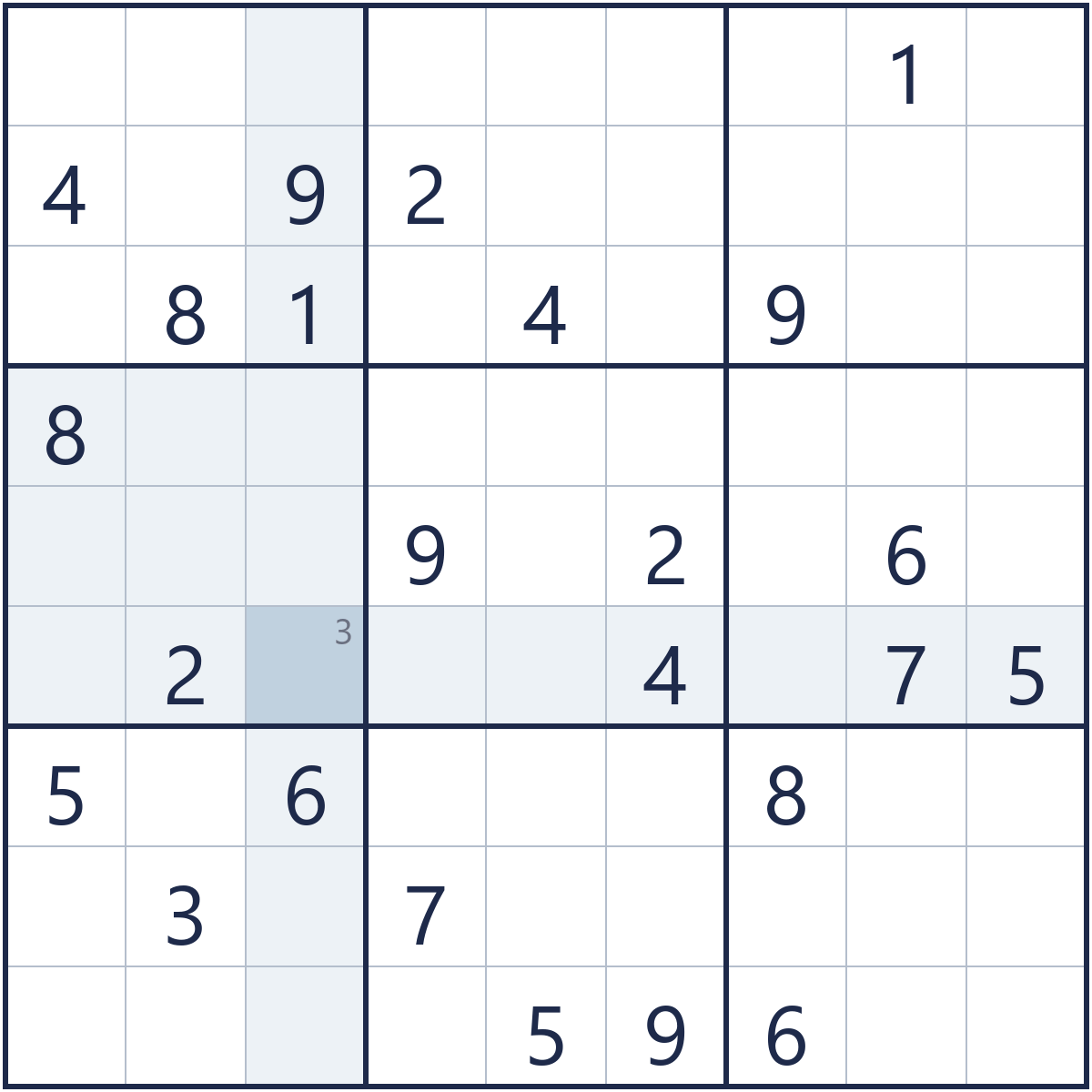
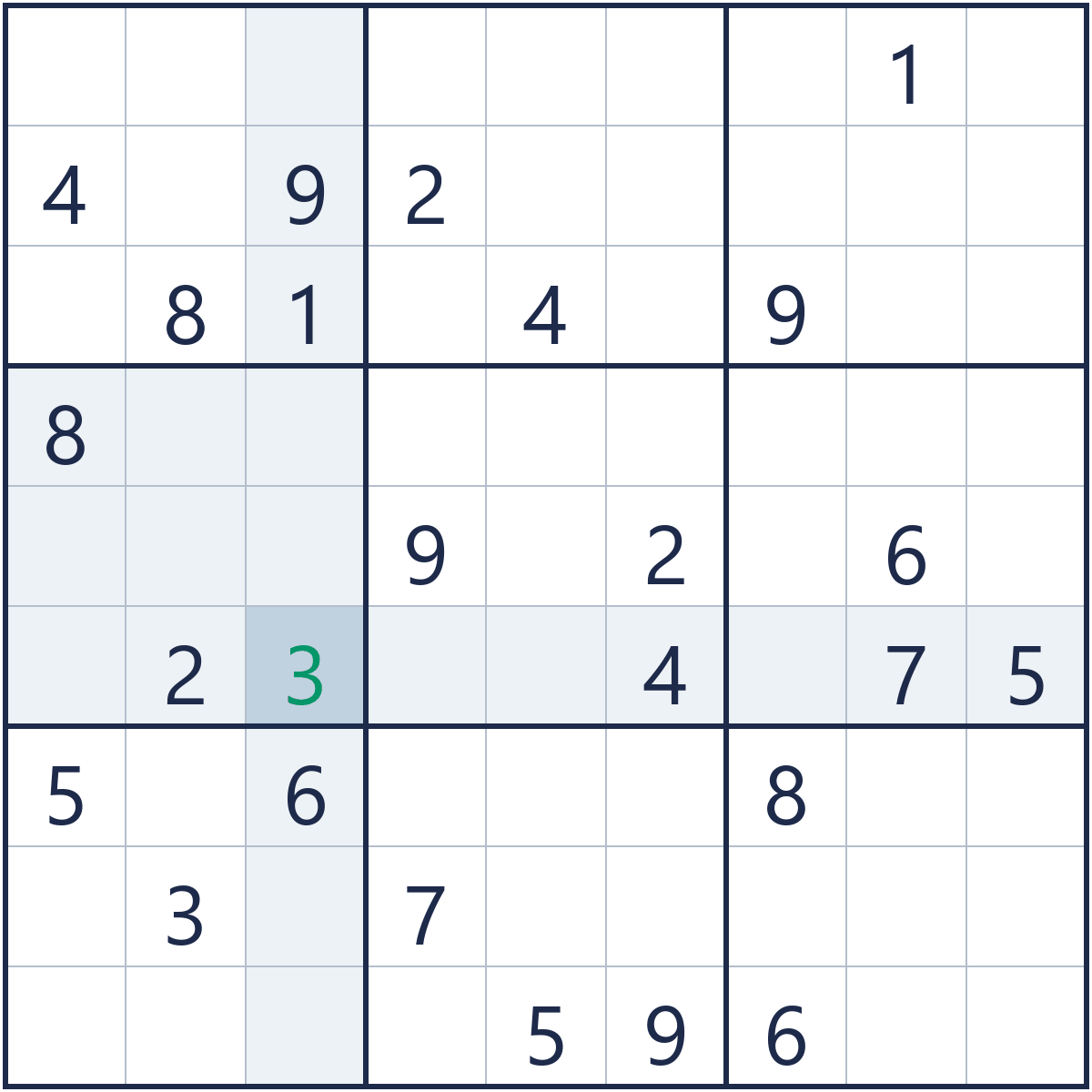
Count the digits r6c3 can see. Row 6 holds 2, 4, 5 and 7. Column 3 holds 1, 6 and 9. The box, rows 4 to 6 and columns 1 to 3, adds the 8, and its 2 is the one already counted in row 6. That rules out eight digits out of nine, and the 3 is what remains.
What should you do when no cell fills?
Check your pencil marks first. A grid that looks stuck sometimes has a candidate missing or erased by mistake. The checks to run, in order, are in what to do when you are stuck on a sudoku.
If the candidates are right, the grid needs a technique that removes candidates instead of placing digits. Pairs come first. A naked pair is two cells in one unit that hold the same two candidates and nothing else. A hidden pair is two digits that fit in only two cells of a unit, so you can erase every other candidate from those two cells. The X-Wing works across two rows and two columns, and the Y-Wing links three cells that hold two candidates each.
The sudoku techniques guide sorts them by difficulty level, up to Swordfish. Learn them in that order. A pair sits inside one unit, while an X-Wing asks you to compare two rows that may be far apart on the grid. The other SudoKoum guides are gathered on the guides page.
Which beginner mistakes cost you the grid?
Guessing comes first. A wrong guess rarely shows at once. The contradiction tends to appear many moves later, when you can no longer tell which digits depended on it. Write a digit only when you can say why no other digit fits.
Stale pencil marks come second. Each digit you place has to be crossed out of the candidates in its row, column and box. One stale candidate is enough to produce a false pair or a false single.
Partial notes come third. If you mark one box and then reason as if the whole grid were marked, you make eliminations that nothing has proved.
The method has a limit too. Singles finish many easy grids on their own. On harder grids the loop stops before the end, and the rest needs pairs or the X-Wing. You keep the loop running anyway, because each candidate an advanced technique removes can open up a new single.
Checklist before you write a digit
- The digit is missing from the cell's row, column and box.
- No other cell in the unit can take it, or the cell has no other candidate.
- You can name the technique that proves it.
- Once it is placed, you cross it out of the candidates around it.
| Technique | What you look at | What you get |
|---|---|---|
| Last free cell | A unit with one empty cell | The digit the unit is missing |
| Last remaining cell | One digit across a box | The only cell of the box that takes it |
| Hidden single | One digit across a row, column or box | The only cell of the unit that takes it |
| Naked single | The candidates of one cell | The only digit still possible there |
| Naked pairs | Two cells with the same two candidates | Those two digits erased from the rest of the unit |
| Hidden pairs | Two digits limited to two cells | Every other candidate erased from those two cells |
Questions beginners ask about solving sudoku
Do you have to guess to finish a sudoku?
No, as long as the puzzle has exactly one solution. Each of its digits then follows from the givens and the rules. If you feel the urge to guess, recheck your pencil marks first.
Should you write candidates from the very start?
Scan first. Scanning by digit places the easy digits without writing anything, so the candidates you note afterwards are fewer and change less.
Which difficulty should you start with in SudoKoum?
SudoKoum has five difficulty levels, Easy, Medium, Hard, Expert and Extreme. Start on Easy to get used to the loop, then move to Medium once you finish Easy grids without mistakes. The Strategies screen shows the app's 14 techniques, including the X-Wing, the Y-Wing and Swordfish.
And on a hard grid?
The loop is still where you start. When it stops, look for pairs, then for the X-Wing and the Y-Wing. Each candidate they remove can restart the loop.
How do you spot a mistake?
The same digit twice in one unit, or an empty cell with no candidate left, means something went wrong. Go back to the last digit you cannot justify and erase what followed from it.
Do you need to be good at math to solve sudoku?
No. The puzzle asks for no addition and no multiplication. It asks you to check that a digit is missing from a row, a column and a box.
Sources
- Nikoli, Sudoku (rules), nikoli.co.jp, 2021
Be there at launch
SudoKoum is coming to the App Store and Google Play. Leave your email and get a single message, the day the app ships.
Notify me when available