What to do when stuck on sudoku before you start guessing
When you are stuck on a sudoku, look for a mistake before you look for a new technique. Check for a digit placed twice in one unit and for an empty cell with no candidates left. Then refresh your pencil marks, rescan the rows and columns for singles, and look for a naked pair or a pointing pair. Once the singles run out, the pointing pair opens the Expert level of the sudoku techniques guide and the naked pair opens the Extreme level.
What should you check first when you are stuck on sudoku?
Check whether the grid is wrong. A wrong grid and a correct one look the same when no cell will fill, because a mistake does not have to block you on the spot. It removes a candidate that should have stayed, or leaves one that should have gone, and the grid can keep moving for a few more digits before it freezes. An advanced technique run on a wrong grid can pile new errors on top of the first.
Two terms come up below. A unit is any row, column or 3×3 box. A candidate is a digit that can still go in an empty cell, and pencil marks are those candidates written small in the cell.
Four signs give a mistake away: a digit twice in one unit, an empty cell with no candidates, a digit with nowhere to go in a unit that still needs it, and three cells in one unit that share the same two candidates and nothing else. The last one needs a word. Two cells can split two digits between them, one each. A third cell limited to those two digits has nothing left to take, so the grid is wrong somewhere.
Which checklist should you run when no cell will fill?
Run these checks in order and stop as soon as a digit goes in. Each new digit restarts the basic loop from how to solve sudoku step by step.
- Look for a digit that appears twice in a row, column or box.
- Look for an empty cell with no candidates, or a digit with no possible cell in a unit that still needs it.
- Make sure every empty cell has its pencil marks.
- Cross out every digit you placed since you last updated your pencil marks.
- Scan each digit through the rows and columns as well as the boxes.
- Look for a cell with one candidate left.
- Look for a naked pair in each unit, then a pointing pair in each box.
- Move on to hidden pairs, the X-Wing, then the Y-Wing.
Steps 1 and 2 hunt for a mistake. Steps 3 to 6 catch a naked single or a hidden single you missed. A scan that stays inside the boxes lets the hidden singles of rows and columns slip by. Steps 7 and 8 take you past the singles.
How do you find the mistake in a sudoku?
Start from the digits you placed, before you touch the pencil marks. Pick one digit, say 7, and check that no row, column or box holds two of them. Do the same for the other eight digits.
If every placed digit is fine, check the pencil marks of the cells you changed last. Work out the candidates of a cell again from its row, column and box, then compare with what you wrote. A missing candidate that no placed digit rules out was erased by mistake. A candidate that a placed digit can see should have been crossed out.
A duplicate does not tell you which of the two digits is wrong. Go back to the last digit you cannot justify and erase everything that followed from it. If you cannot find where the error started, restart the grid instead of patching cells at random.
How does a naked pair get the grid moving again?
A naked pair is two cells in one unit that hold the same two candidates and nothing else. Those two digits will end up in those two cells, one each, so you can cross them out of every other cell in the unit. In the grid below, r4c8 means row 4, column 8.
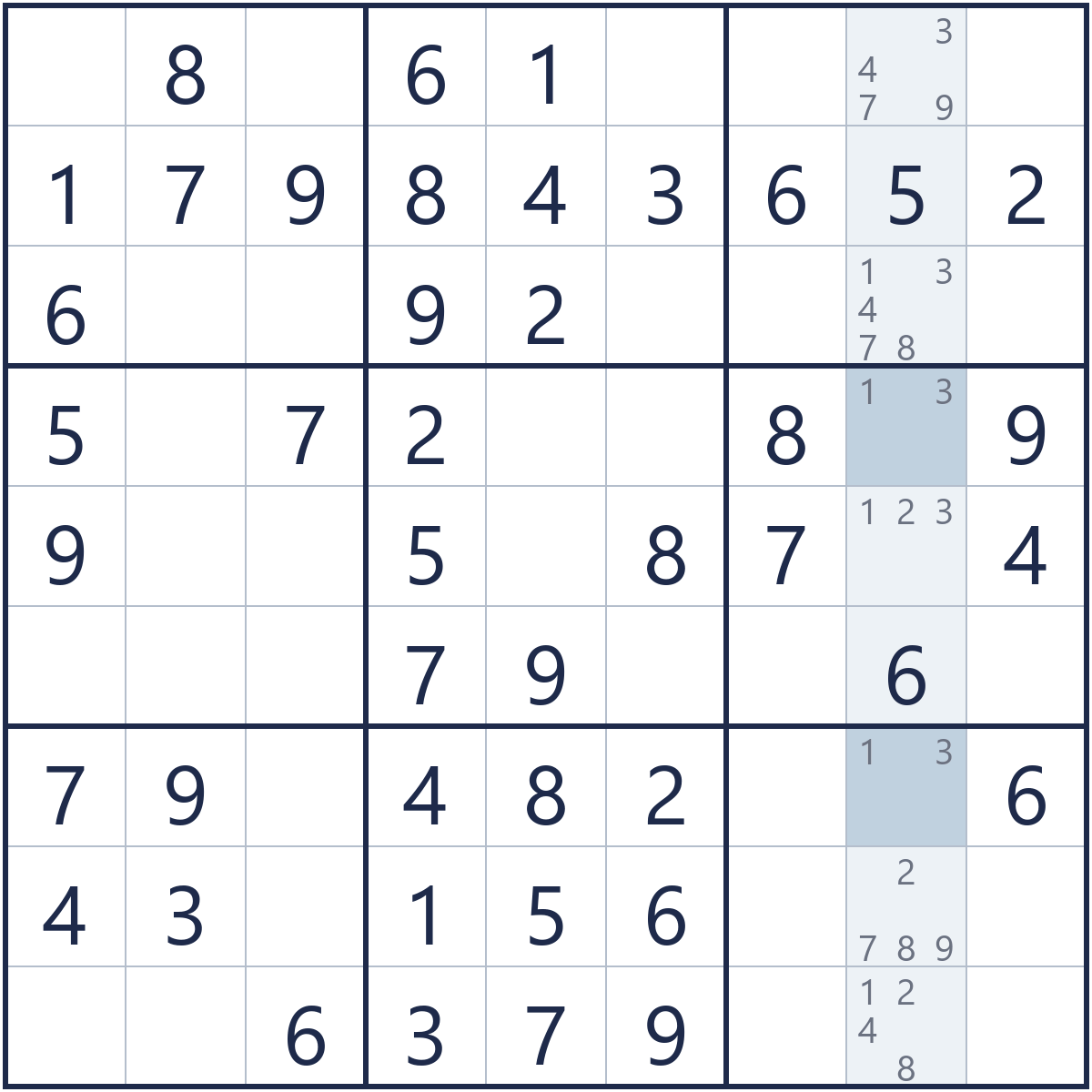
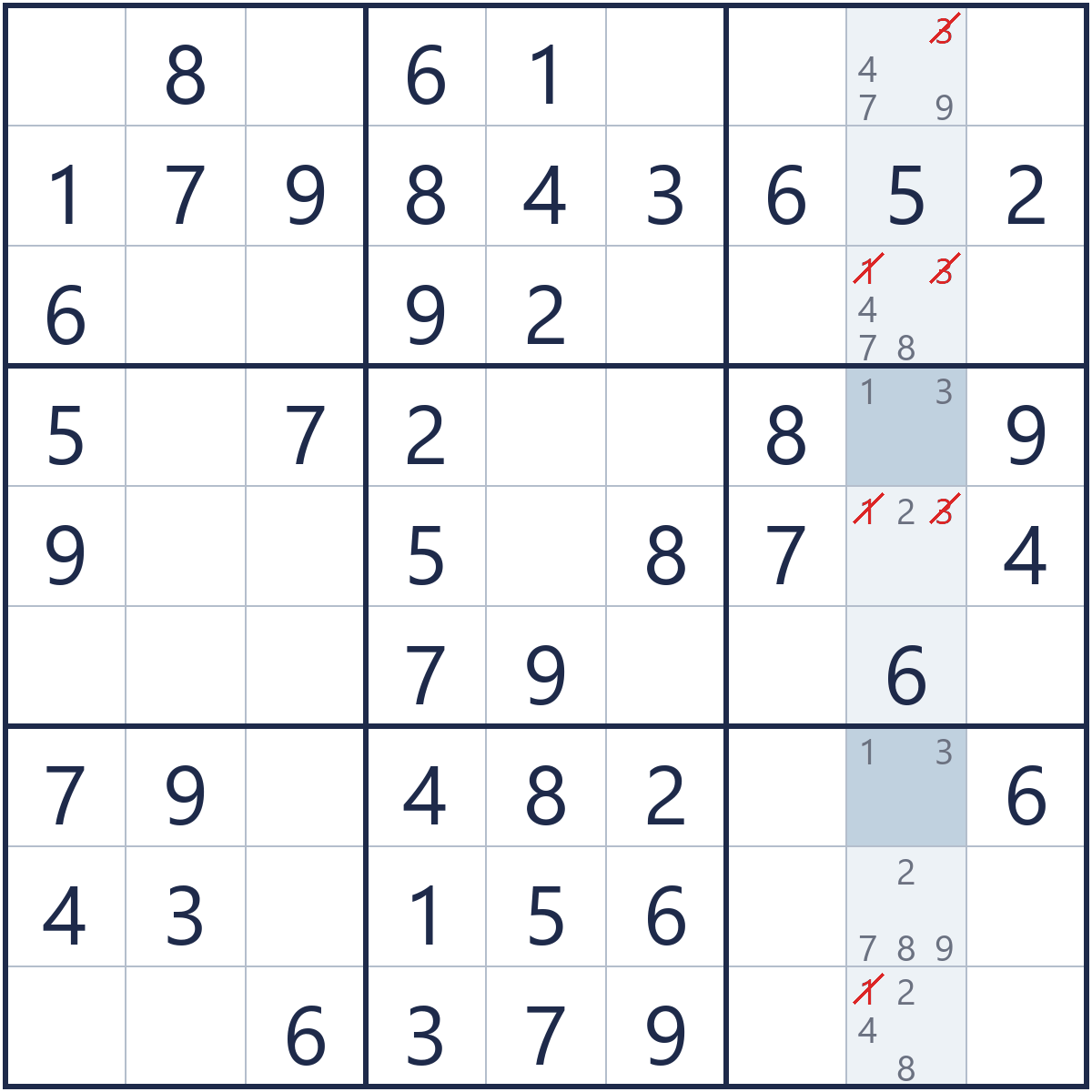
Look down column 8. Cells r4c8 and r7c8 both show 1 and 3, with no other candidate. One will take the 1 and the other the 3, so no other cell in the column can hold either digit. Cross the 3 out of r1c8, both digits out of r3c8 and r5c8, and the 1 out of r9c8.
Now look at r5c8. It had three candidates, 1, 2 and 3. Once the pair is applied, only the 2 is left. That is a naked single, and the 2 goes in.
What is a pointing pair in sudoku?
A pointing pair appears when a digit, inside one box, can only go in cells of a single row or column. The digit will land in that box on that line, so it cannot go anywhere else along the line outside the box. HoDoKu, the solving program by Bernhard Hobiger, files this under locked candidates, as Locked Candidates Type 1 (Pointing).
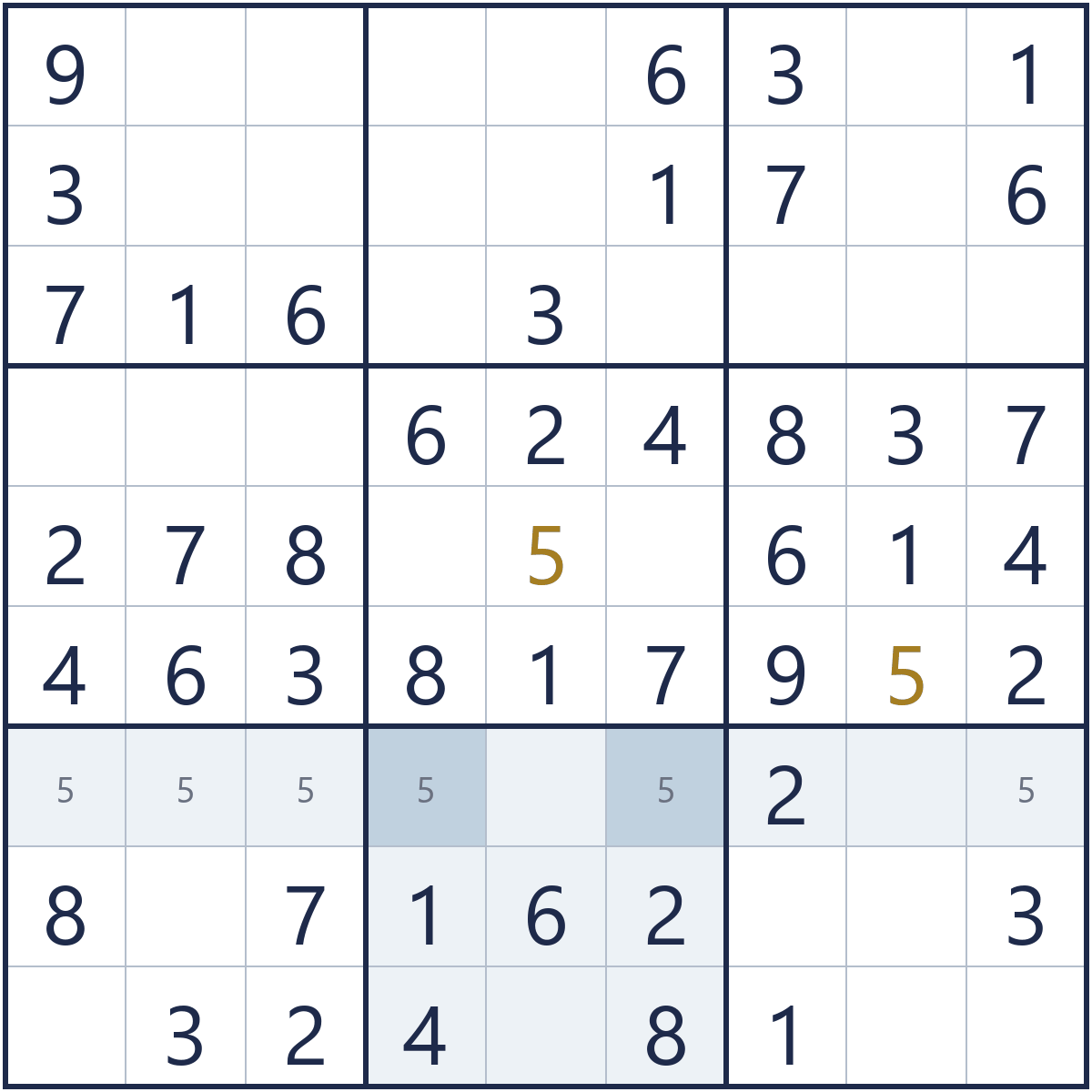
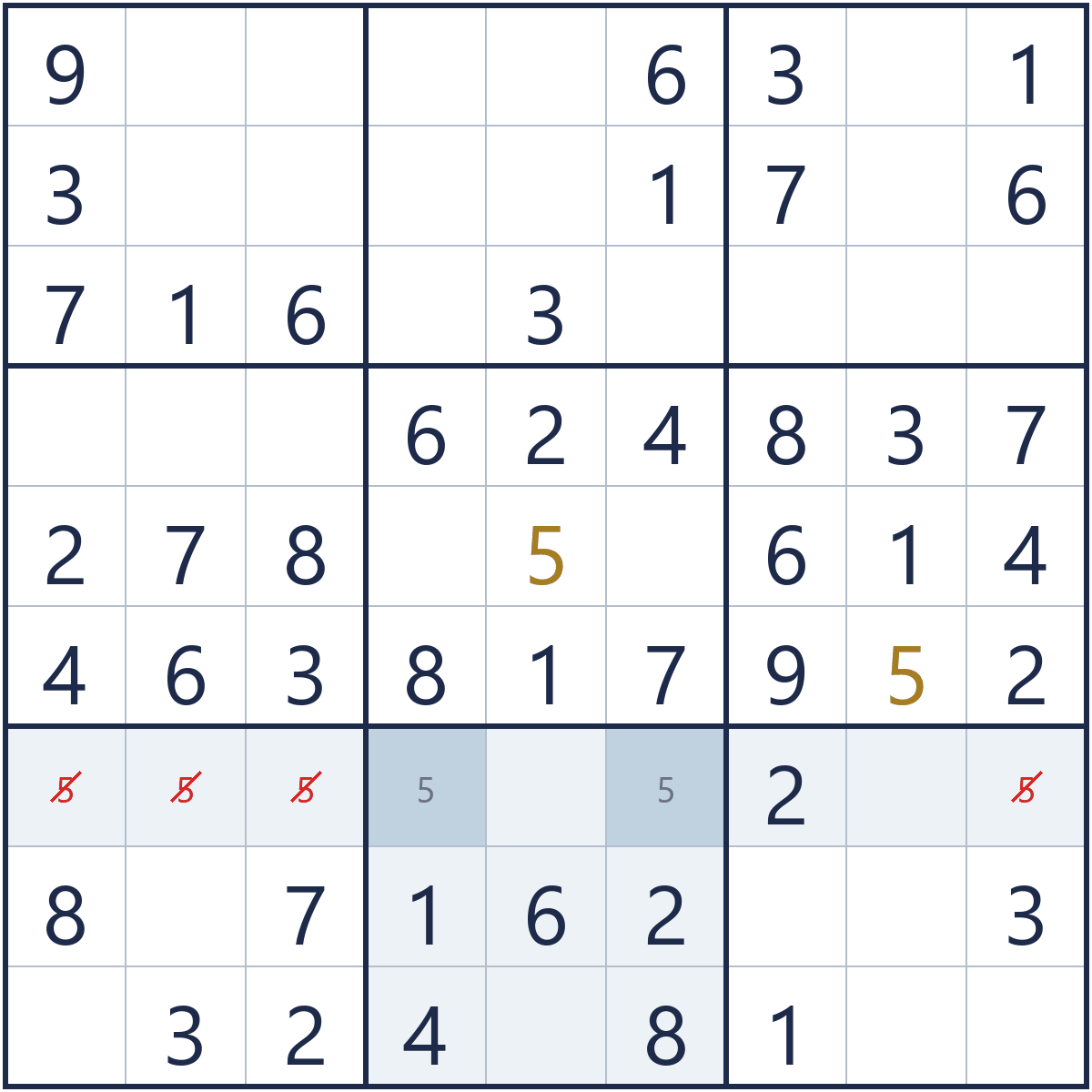
Boxes are numbered left to right and top to bottom, so box 8 is the bottom middle one. The 5 is missing there and fits only in r7c4 and r7c6. Both cells sit in row 7, which means the 5 of row 7 is inside box 8. Cross the 5 out of r7c1, r7c2, r7c3 and r7c9.
The same reading works with a column. Pointing triples apply it to three cells lined up inside one box.
Why look for these two before anything else?
Both show up directly in your pencil marks. A naked pair is two cells in one unit that hold the same two candidates and nothing else. A pointing pair is a box where a digit is left as a candidate on a single row or column. A hidden pair, by contrast, asks you to count where each digit can go, cell by cell, which takes longer. The sudoku techniques guide puts pointing pairs first in the Expert level, right after the singles. Naked pairs open the Extreme level.
If neither gives you anything, look for a hidden pair, two digits that fit in only the same two cells of a unit. Then try the X-Wing, which follows one digit across two rows, and the Y-Wing, which links three cells that hold two candidates each. Swordfish comes after them, at the same Extreme level of the techniques guide.
Which habits keep a sudoku stuck?
Watch first for a false naked pair. Two cells showing 1 and 3 form a pair only if neither holds any other candidate. In the example grid, r5c8 also shows 1 and 3, but its 2 keeps it out of the pair.
A pointing pair has its own trap. The digit must be gone from every other cell of the box. One candidate left in the box outside the row cancels the deduction.
Partial pencil marks spoil both techniques. A naked pair spotted in a column where three cells have no marks proves nothing, since one of those cells could hold one of the two digits.
Guessing carries a risk of its own. A wrong digit can sit unnoticed for many moves, and by the time the grid breaks you no longer know which cells depended on it.
Pairs have a limit too. They remove candidates and place nothing by themselves. A pointing pair removes nothing when the digit is no longer a candidate elsewhere in the row. When that happens, carry on down the checklist.
Questions about a stuck sudoku
Should you guess when you are stuck on sudoku?
No. A well-made puzzle has one solution, and each of its digits follows from the rules. Go back to step 1 of the checklist before you bet on a digit.
How do you solve a hard sudoku when you are stuck?
Run the checklist, then look for pairs, then the X-Wing and the Y-Wing. Each candidate those techniques remove can reveal a new single, so rescan after every removal.
How can you tell the grid has a mistake?
A digit twice in one unit, an empty cell with no candidates, or a digit with nowhere to go in a unit that still needs it. One of these signs is enough.
Should you restart the grid?
Only if you cannot find where the mistake began. If you know which digit you cannot justify, erase it and everything that followed, then carry on from there.
Where can you see these techniques in SudoKoum?
The Strategies screen shows the app's 14 techniques, from the last free cell to Swordfish, naked pairs and pointing pairs included.
Sources
- Bernhard Hobiger, HoDoKu, Solving Techniques, Intersections (Locked Candidates, pointing and claiming), hodoku.sourceforge.net, 2012
Be there at launch
SudoKoum is coming to the App Store and Google Play. Leave your email and get a single message, the day the app ships.
Notify me when available